STORY
Engineering story
How the platform was scoped, built, and refined.
DevLaunch Systems had project and case-study content duplicated across separate applications, with each application maintaining its own copy and presentation rules. Updating a project in one place meant manually updating it elsewhere, creating duplicate work, inconsistent content, and tighter coupling between applications. The broader business also needed a reusable foundation for media, public inquiries, notifications, and CRM integrations without turning any individual application into the integration hub.
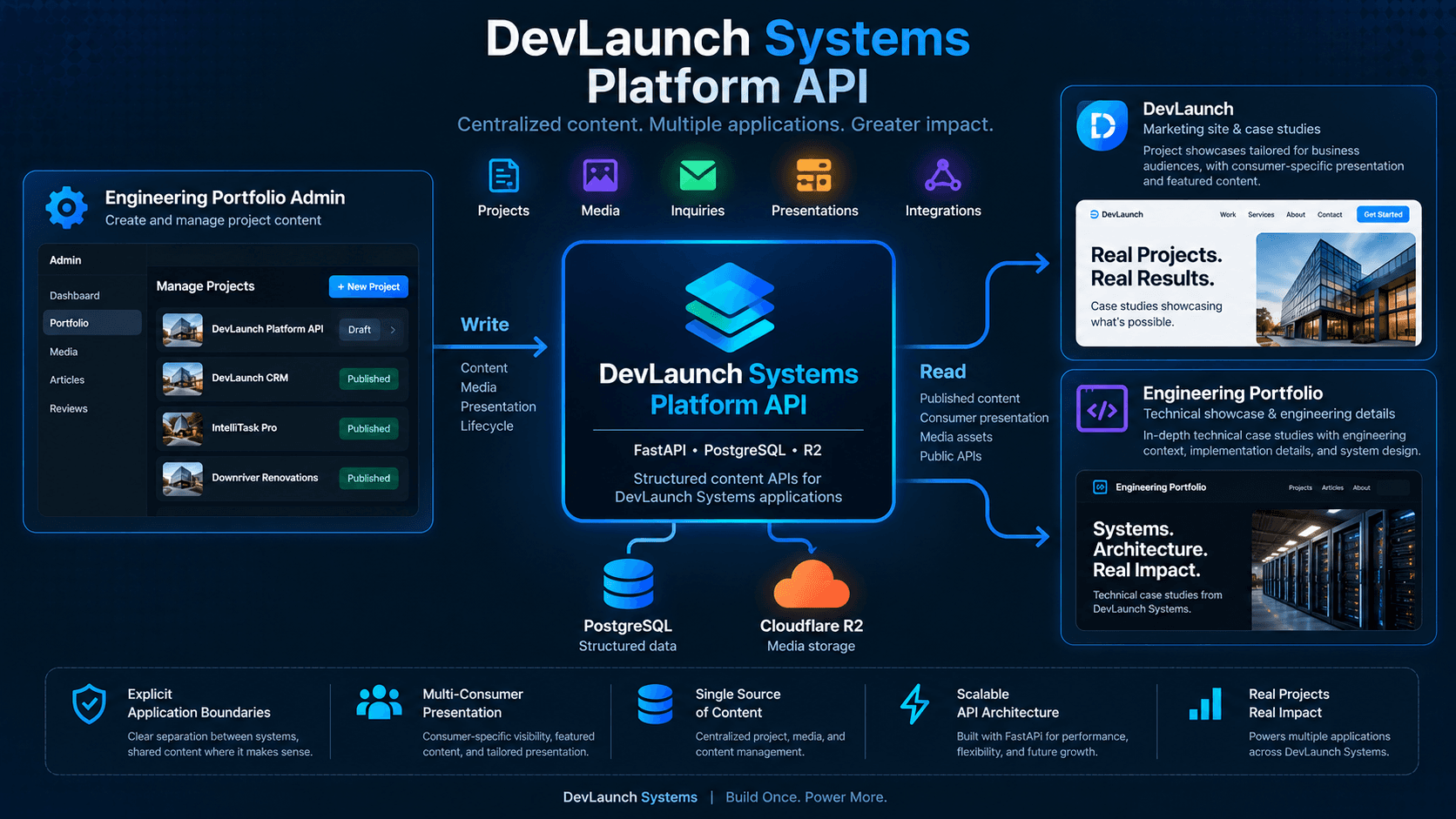
I designed and built a centralized Platform API that establishes a single authoritative source for shared project and case-study content while allowing each consuming application to control how that content is presented to its audience. The platform provides authenticated administrative APIs, public read APIs, media management, inquiry workflows, notifications, and CRM handoff. Engineering Portfolio became the management surface for shared project content, while both Engineering Portfolio and the DevLaunch Systems public site consume the Platform independently.
Architecture
The platform is a standalone FastAPI service backed by PostgreSQL with SQLAlchemy 2.x and Alembic migrations. Public content endpoints support anonymous read access, while administrative and integration operations use scoped service credentials with hashed token storage, rotation, revocation, and usage tracking. Cloudflare R2 provides object storage for managed media, with the Platform retaining authoritative media metadata and lifecycle state. Consumer-specific settings control visibility, featured status, ordering, and presentation independently for Engineering Portfolio and DevLaunch Systems. Application boundaries remain explicit: Engineering Portfolio writes shared content to the Platform, both public sites read from the Platform, and operational CRM data remains owned by the CRM rather than being merged into the content domain.
The hardest part was establishing authority boundaries while migrating systems that already had working local data models and production behavior. Shared content had to move to Platform ownership without breaking existing routes, public pages, media, or rollback paths. Multi-consumer presentation introduced another challenge: the same project needed shared canonical content while allowing different visibility, ordering, featured state, and audience-specific copy. Maintaining atomic collection updates, media ordering, lifecycle behavior, cache consistency, and transactional CRM handoff required careful contracts and regression testing across multiple repositories.
Centralizing data is less about moving records than clearly defining ownership. The safest approach was to migrate authority incrementally: establish contracts first, introduce Platform-backed reads, freeze legacy writes, migrate administrative workflows, and only then retire local authority. Cross-application systems also require testing the seams between services, not just each service independently. Production smoke testing exposed integration and cache behaviors that isolated test suites could not fully demonstrate.
Future improvements include asynchronous retry workers for notification and CRM handoff failures, a transactional outbox for stronger delivery guarantees, automated reconciliation of cross-system audit state, service credential rotation workflows, richer observability with distributed tracing, and more advanced abuse protection if traffic warrants it. Media infrastructure could also evolve toward a more generalized asset model as additional Platform-owned content types are introduced.
Features
What the product or platform delivers.
- Centralized project and case-study content API
- Multi-consumer visibility, featured state, ordering, and presentation
- Authenticated administrative APIs with scoped service credentials
- Public read APIs with consumer-specific projections
- Cloudflare R2 media upload, registration, and metadata management
- Project metrics, milestones, gallery, and lifecycle management
- Public inquiry intake and lifecycle management
- Post-commit owner notifications with delivery auditing
- CRM inquiry handoff with integration audit history
- Transactional collection updates and atomic ordering
Responsibilities
What I personally designed, built, or owned.
- Designed the cross-application platform architecture and ownership boundaries
- Defined API contracts and consumer-specific content projections
- Built the FastAPI, SQLAlchemy, PostgreSQL, and Alembic backend
- Designed scoped service authentication and authorization
- Implemented media workflows backed by Cloudflare R2
- Built inquiry, notification, and CRM integration workflows
- Migrated existing applications from local content authority to Platform-backed reads and writes
- Designed migration, compatibility, and rollback boundaries across applications
- Built automated regression, architecture, migration, and container validation
- Managed production rollout and cross-application integration testing